
Working as a legal search professional is an extraordinarily meaningful and impactful career – and also one that brings a continual stream of pressure, unpredictability, and sudden urgency. Whether you work in a law firm, a company, or a search firm, your days are shaped by shifting priorities, demanding clients, emotionally charged candidates, and deadlines that seem to multiply on their own.
At the 2025 NALSC Fall Symposium, we explored a set of science-based techniques designed to help you not only withstand this chaos, but thrive within it. If you joined us in the room, think of this article as a reinforcement tool to help you successfully implement these methods. If you weren’t able to attend, this article captures the core insights you missed – and how to start using them right away.
No matter how successful and talented you are as a search consultant, you likely desire these two outcomes:
- To feel less stressed and more emotionally resilient, and
- To perform with greater focus, productivity, and quality.
These three techniques will directly support you in achieving both outcomes.
1. Reframe Stress as Energy (Rather than Nervousness)
Most professionals respond to stress with a familiar internal script: Calm down. Look confident. Don’t let anyone see you’re nervous. Unfortunately, nearly a decade of scientific research shows that this attempt to “get calm” under pressure is counterproductive. It actually increases anxiety, lowers confidence and resilience, and impairs cognitive performance.
Why? Because your body is already in a state of high activation. When you tell yourself to relax instantly, your brain interprets the mismatch as failure: I’m stressed…and I shouldn’t be. This creates secondary stress (i.e., stress about being stressed), further activating the amygdala (your brain’s threat center) and reducing functioning in the prefrontal cortex – the region responsible for executive thinking, focus, decision-making, social cognition, verbal fluency, and working memory.
A simple alternative is far more effective: Interpret the physical sensations of stress as energy, excitement, or determination. And as something that will improve your performance.
Tell yourself: “This stress is a sign that I care deeply about the quality of my work! It’s energy moving through my body and into my brain, which will induce me to perform better and accomplish more!”
The science reveals that this subtle shift will, in fact, cause your brain to perform better and accomplish more on the cognitive task at hand, while inducing you to feel more resilient in the process. Unsurprisingly, elite performers – from athletes to public speakers – channel their heightened arousal into focus and drive. You may not have three available hours for meditation in the midst of a chaotic day, but you do have 10 seconds to perform this reframe. Research consistently shows that people who briefly reinterpret their stress as empowering energy feel better and perform better on high-pressure cognitive tasks ranging from exam-taking to negotiations to presentations.
The stress signal is not the enemy. Your interpretation of it is.

2. Transform Your Mini-Breaks to Rejuvenate Your Brain
very day, you take dozens of small breaks – between calls, between emails, between tasks. Some of these breaks may last just a couple of minutes, while others may be a full lunch break or a 30-minute pause. Unfortunately, the vast majority of people unwittingly use these breaks in ways that further exhaust their brains. Now that’s irony at its finest!
Social media, web browsing, news scrolling, texting, and even online shopping are highly common short-break activities because they feel enjoyable and relaxing, but they actually require the same mental machinery you use for your work: reading comprehension, attention control, information filtering, critical appraisal, analytical judgment, working memory, and micro-problem-solving (even if only in one’s own mind). This keeps your prefrontal cortex “on duty” – in fact, highly active – and prevents genuine recovery. Even in-person socializing or talking on the phone with a friend or loved one feels good, but severely taxes your brain.
Your brain isn’t asking for stimulation during a break; it’s asking for rejuvenation. Yet, we unconsciously conflate “mentally stimulating activities” (like each of the above activities) with “cognitively rejuvenating activities.” Unfortunately, the vast majority of mentally stimulating activities – which we impulsively lunge towards in order to distract ourselves from the stressors of our day – are actually cognitively depleting, which is why you stare blankly at that candidate’s resume immediately after returning from your 30-minute break. You technically took a break, but your brain didn’t.
A simple rule can transform your entire day – the 80/20 Break Rule:
- Spend the first 80% of each break doing whatever enjoyable – yet cognitively-depleting – activity you’d like (see, I’m not trying to deprive you of joy in life!)
- Reserve the last 20% of each break for an activity that involves neither language nor logic (the two “L’s”) – and therefore replenishes the brain rather than depletes it.
By engaging in this simple act of intentionality, you’ll regain control of your brain and give it the renewal it desperately needs. You’ll still allow yourself to spend 80% of your breaks doing enjoyable and stimulating activities, but you’ll ensure that your yearning for enjoyment and stimulation doesn’t undermine your brain’s ability to recover and function effectively. If you take a 10-minute break, for instance, spend the last two minutes engaged in non-intellectual activities. If you take a 30-minute break, spend the last six minutes engaged in non-intellectual activities. You’ll be surprised at how impactful this small change will be. Examples of such activities include:
- A short walk without your phone
- Light stretching
- Looking at nature (even a plant or a photo of nature)
- Folding laundry or doing dishes
- Playing with a pet
- Listening to familiar music
- Gardening, weaving, Legos, or other tactile activities
- Drawing, painting, or doing anything artistic
- Doing a puzzle, playing Tetris, or anything involving spatial processing
- Engaging in something intentionally boring (boredom is great for the brain!
As long as the activity involves neither of the two “L’s” (language or logic), your brain’s highest regions will begin rejuvenating so they’re ready to fire on all cylinders when you begin working again. Even two minutes of non-cognitive activity during a 10-minute break can restore cognitive resources, increase resilience, and immediately improve your energy and productivity for your next round of work.
These benefits do not take weeks to appear. You’ll experience them immediately.

3. Navigate Acute Stressors with S.O.D.A. and The 90-Second Rule
You’re working through your day when suddenly it hits – the aggressive email, the triggering text, the demoralizing update, the thought of a deadline you forgot. Your body floods with stress hormones, and your brain instinctively wants to white-knuckle through it: Just fix it now. Respond now. Power through so you can get it off your plate ASAP. Then you’ll feel better!
But when you act during this first jolt of stress, you reinforce a harmful set of neural pathways that link the emotion of stress to this impulsive action. The more you react to stress with such impulsive action, the more reactive, less resilient, and more prone to emotional overwhelm your brain becomes. In this way, the “power through” mentality actually trains your brain to become more stressed and more overwhelmed over time.
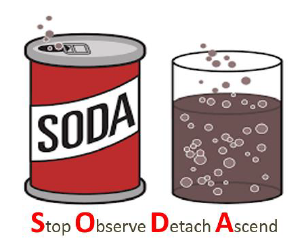
Instead, try this simple pattern interrupt – reach for a S.O.D.A:
- Stop: Pause your instinct to react. Literally don’t take any action.
- Observe: Name the emotion in one word (e.g., anxious, overwhelmed, disrespected, afraid). Naming an emotion reduces amygdala activity and increases perspective and feelings of resilience.
- Detach: Create physical distance for a moment — put the phone down, push your chair back, or turn away from the screen.
- Ascend: For 90 seconds, engage in any activity not tied to the stressor: take a few deep breaths, count to 90, watch a short YouTube clip, walk to the other side of your home and back, pet your dog, engage in a brief gratitude exercise.
This 90-second window is the key. Famed neuroscientist Dr. Jill Bolte Taylor discovered that the biochemical lifespan of an acute emotional reaction is 90 seconds. If you can resist acting during this brief window, your brain settles, and you break the automatic stress-reaction loop. Each time you do this, you train your brain to become ever-so-slightly less reactive and ever-so-slightly more resilient.
Over weeks and months, those small rewires add up to major change. Your baseline level of resilience – in the face of the inevitable triggers of the day – elevates higher and higher over time. You therefore become a more peaceful and more unflappable version of yourself, one S.O.D.A. at a time.
Bringing It All Together
“Challenges and difficulties are unavoidable in a career as a legal search professional, but suffering as a result of them is not.”
Small changes in how you manage your mind and your micro-behaviors can lead to profound improvements in your emotional well-being, resilience, cognitive performance, and productivity.
You have chosen a meaningful profession in which you positively impact people’s careers, livelihoods, and lives. You deserve tools that allow you to thrive while doing so.
ABOUT THE AUTHOR:

Jarrett Green, Esq., M.A., graduated from UC Berkeley School of Law and then practiced commercial litigation for 12 years, first at Skadden Arps and then at his own boutique litigation firm. He left the practice of law about 10 years ago to live his passion of helping lawyers, legal professionals, and other high-stress individuals experience less stress, more happiness, optimized performance, better leadership, and enhanced overall success. He has a Master’s in psychology with emphases on neuroscience, positive psychology, and cognitive-behavioral psychology from Pepperdine University, as well as Certifications in Executive Coaching, Mindfulness, and Stress Management. He works with nearly half of the AmLaw 100 law firms and many Fortune 500 companies and teaches classes on well-being and performance optimization at USC Law School and UC Irvine Law School.
Email: Jarrett@NKBconsultancy.com
Website: www.NKBconsultancy.com